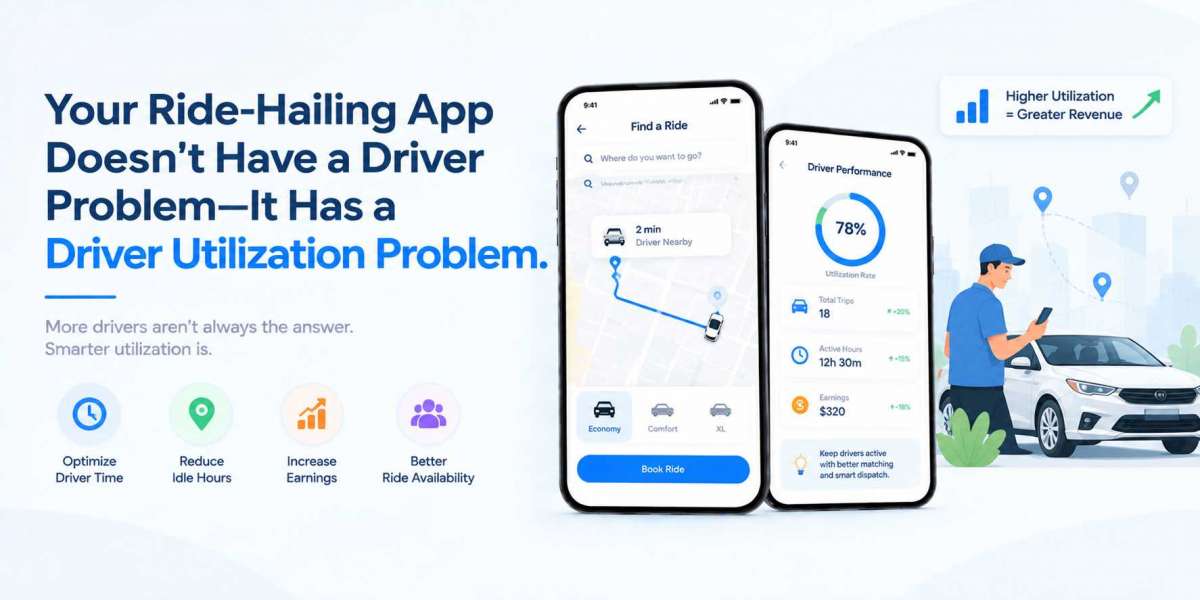

But there is another question that can have a bigger impact on marketplace performance:
How much of a driver's available time actually becomes a paid trip?
A driver can stay online for several hours without receiving enough profitable bookings. When that happens repeatedly, driver satisfaction can fall, availability can shrink, and the platform may have to spend more on incentives to keep supply active.
For entrepreneurs building a , improving driver utilization can therefore become an important business strategy.
More Drivers Don't Automatically Mean Better Coverage
Adding hundreds of drivers to a platform sounds like a straightforward way to reduce customer waiting times.
But if those drivers are concentrated in the wrong locations or active during the wrong hours, the additional supply may not solve the underlying problem.
A smarter platform looks at:
- Where ride requests are increasing
- When demand peaks
- Which areas have excess driver supply
- How long drivers remain idle
- Which routes generate recurring demand
This allows businesses to position supply around actual demand rather than simply increasing the driver count.
Scheduled Rides Can Give Drivers a Better View of Their Day
On-demand rides are unpredictable.
Scheduled bookings introduce a degree of certainty.
Bolt's driver communications highlight scheduled rides that can be accepted in advance, allowing drivers to plan their availability around upcoming trips.
For a ride-hailing startup, scheduled airport transfers, corporate commutes, school transportation, and event rides can create a more predictable layer of demand alongside immediate bookings.
That can make driver availability easier to plan.
The Real Metric Isn't Drivers Online—It's Productive Driver Hours
Imagine two platforms.
Platform A has 10,000 drivers online.
Platform B has 6,000 drivers, but a larger percentage of their online time is spent completing trips.
The second platform may have a more efficient marketplace.
That is why ride-hailing businesses should look beyond driver registrations and monitor metrics such as completed trips per active hour, idle time, acceptance rates, utilization by zone, and demand-to-supply ratios.
The objective is not simply to build a bigger driver network.
It is to make the existing network work harder.
Better Utilization Can Strengthen the Entire Marketplace
When drivers receive more relevant trips, customers can benefit from better availability.
When customers receive faster matching, ride demand can increase.
When demand becomes stronger, drivers have more reason to remain active.
That creates a marketplace loop:
Better matching → less idle time → stronger driver engagement → better availability → more bookings.
Technology becomes the mechanism connecting all these pieces.
Build the Platform Around Marketplace Efficiency
A modern Bolt-style ride-hailing platform can combine intelligent driver matching, real-time tracking, demand heat maps, scheduled bookings, route optimization, dynamic pricing, driver availability controls, earnings dashboards, and automated dispatch.
SpotnRides platform provides the technology foundation for entrepreneurs to build a branded ride-hailing marketplace with customer, driver, and admin applications while adapting features and monetization models to their target market.
The bigger business opportunity isn't necessarily getting more drivers onto your platform.
It's making every available driver more likely to be in the right place, at the right time, with the right ride.