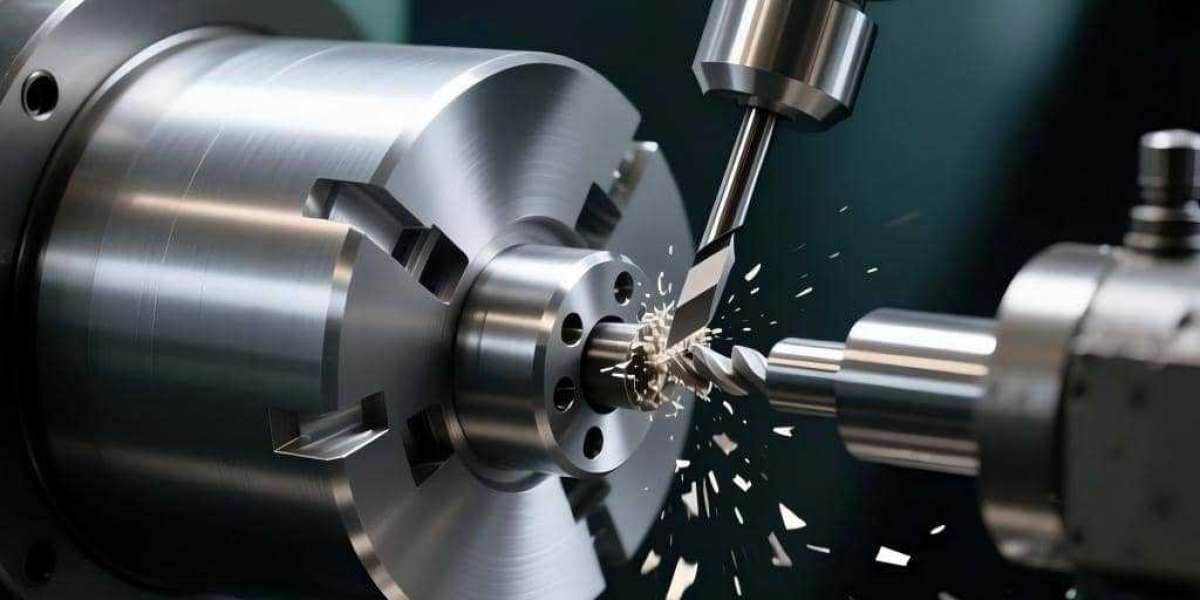

Few manufacturing processes are as versatile as CNC turning. It can produce a simple aluminum bushing or a complex titanium medical screw. It can support high-volume automotive production and low-volume aerospace prototyping. For companies that need cylindrical accuracy, a professional Chine CNC turning service is often the fastest route from drawing to finished component. When the application involves an aluminum aerospace machined component or high precision medical part machining, turning becomes even more valuable because roundness, concentricity, and surface finish directly affect performance.
Turning is based on rotation. The workpiece spins on a lathe spindle while a stationary tool removes material. This makes it naturally suited to shafts, pins, bushings, nuts, connectors, spacers, hubs, valves, and threaded parts. In aerospace and medical projects, many critical components are rotationally symmetrical, even if they also require milled flats, slots, or cross holes.
In aerospace, turned parts often appear in hydraulic systems, instrument assemblies, brackets, fasteners, bushings, and structural connectors. An produced by turning may be a lightweight spacer or sleeve where weight reduction matters. Aluminum grades such as 6061 and 7075 are common because they are easy to machine and offer good strength relative to weight. The turned surface must often be smooth, burr-free, and dimensionally stable.
Aerospace turning also requires process discipline. Parts may need tight outer-diameter tolerance, accurate thread fit, concentric bores, and clean shoulder transitions. If the part is later anodized, the machined surface quality affects the final result. JTR’s turning team selects tools and cutting parameters to reduce vibration, control heat, and maintain accuracy across the batch.
Medical turning is different in risk profile. A poorly machined automotive bracket may cause noise or fitment issues. A poorly machined medical pin or screw can affect patient safety. Therefore, requires stricter control of burrs, surface roughness, threads, and material integrity. Stainless steel 316L, titanium TC4, and PEEK are common choices depending on the device.
A surgical shaft, for example, may be turned to a very fine diameter with a polished surface. A bone screw may require precise thread formation and a clean transition between head and shank. A dental component may need concentric internal features and a biocompatible surface. These parts are not “general machining” jobs; they require careful toolpath planning and inspection.
This is where a professional adds value. Modern CNC lathes can control feed, speed, depth of cut, and tool position with high repeatability. Turn-mill centers can even perform milling operations after turning, reducing the need to re-clamp the part. Fewer clamping steps mean better concentricity between the turned diameter and any milled feature.
Finishing is also essential in both industries. Aerospace aluminum parts may need anodizing for corrosion protection. Medical stainless parts may need passivation. Titanium medical parts may need polishing or surface cleaning to reduce contamination risk. Some components may require electropolishing-like smoothness, while others only need deburring and cleaning.
JTR’s finishing capabilities support these requirements with anodizing, passivation, polishing, bead blasting, plating, powder coating, and painting depending on material and application. For aerospace and medical work, the key is not choosing the most aggressive finish but the most suitable one. A finish should improve function without hiding dimensional problems or introducing contamination.
Another advantage of CNC turning is prototype speed. Both aerospace and medical projects often begin with small batches. Engineers need to check fit, weight, thread engagement, clearance, and surface feel before committing to production. Turning programs can be created quickly from CAD files, and sample parts can be machined without expensive tooling. This supports faster design validation.
Material traceability is also important. Aerospace and medical buyers usually care about the correct alloy grade, certificate of material, and consistent stock quality. JTR works with common CNC materials including aluminum, stainless steel, carbon steel, brass, copper, titanium, and engineering plastics. For critical projects, material verification and inspection reports help close the quality loop.
Tolerance is often the deciding factor. Standard CNC turning can handle typical cylindrical tolerances, while precision turning can reach tighter limits depending on diameter, length, material, and machine condition. Long thin shafts need special support to avoid deflection. Small threads need correct tool geometry. Thin-walled tubes need careful clamping to avoid distortion. Experienced machinists anticipate these issues before production starts.
In aerospace assemblies, a turned bushing may look simple but still carry strict requirements. It must seat correctly, support a pin or bearing, resist corrosion, and maintain dimensions under temperature changes. In medical assemblies, a turned connector may need smooth internal bores, precise thread pitch, and zero burrs. The same process principles apply: stable clamping, sharp appropriate tooling, correct speeds and feeds, and verified measurement.
JTR’s combined services make this easier. A part can be turned, milled, finished, and inspected in one workflow. For example, a medical shaft may be turned to diameter, threaded, then slot-milled. An aerospace sleeve may be turned, lightly knurled or grooved, then anodized. Keeping the process in one supplier reduces handling errors and shortens lead time.
Global customers often choose Chinese CNC suppliers for responsiveness and cost efficiency. However, for aerospace and medical work, capability matters more than price alone. The supplier must understand tolerances, materials, cleaning, deburring, inspection, and documentation. JTR’s pages show experience across aerospace, medical, automotive, semiconductor, and industrial components, which indicates broader process maturity.
Looking forward, demand for precise turned components will keep growing. Electric vehicles need compact shafts and sensor housings. Aerospace systems need lightweight aluminum and titanium parts. Medical devices need smaller, smoother, more complex implants and instruments. A reliable Chine CNC turning service can support all three industries by delivering consistent cylindrical accuracy.
In conclusion, CNC turning is not a outdated manual process. It is a high-precision digital manufacturing method. Whether producing an aluminum aerospace machined component, a surgical pin, a hydraulic bushing, or a custom shaft, turning provides speed, accuracy, and repeatability. Combined with high precision medical part machining discipline and proper finishing, it becomes a strong solution for safety-critical and performance-critical industries.