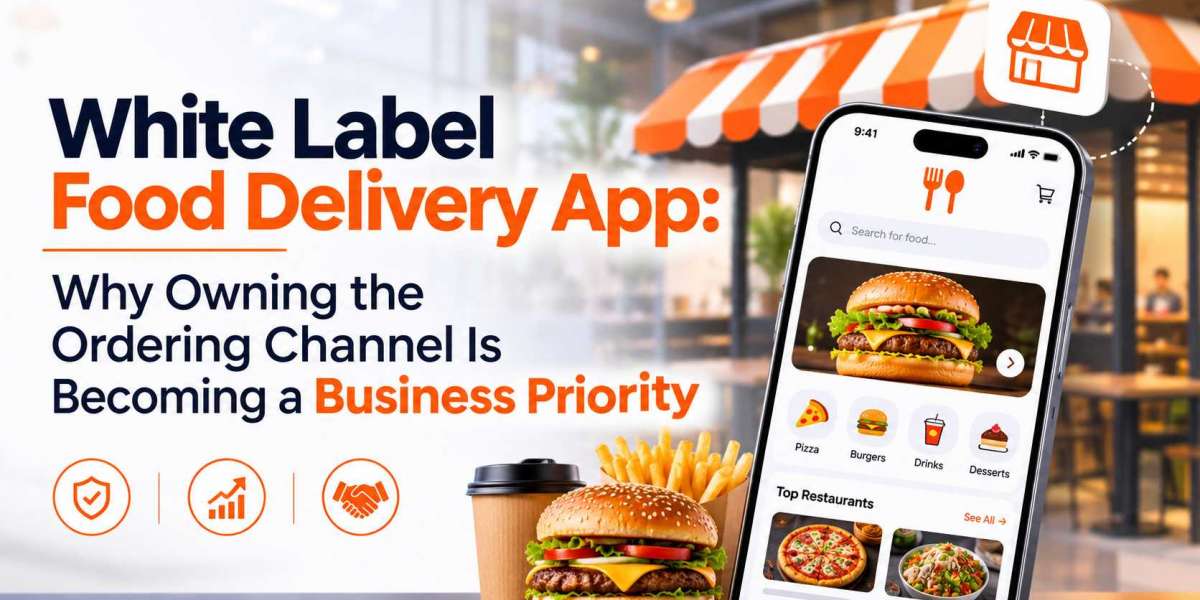

For years, restaurants and food entrepreneurs have relied on third-party delivery marketplaces to reach online customers. These platforms offer visibility and access to an existing customer base, but they also create a business dependency. Restaurants have limited control over customer relationships, promotional strategies, platform policies, and the overall ordering experience.
This is changing how businesses approach food delivery technology.
Restaurant chains, cloud kitchen operators, food startups, and regional delivery businesses are increasingly interested in developing their own branded ordering channels. They want to build direct customer relationships, control their digital presence, and create revenue opportunities beyond third-party marketplace commissions.
A addresses this business requirement by providing ready-made technology that can be customized and launched under a company's own brand.
But the bigger question is not simply how to get an app. It is how to use ownership of the ordering channel to build a stronger food delivery business.
1. The Business Is Moving from Marketplace Dependence to Channel Ownership
Third-party marketplaces can help restaurants attract customers, but businesses may find it difficult to establish direct relationships with those customers.
Consider a restaurant group operating multiple outlets. Every time customers order through an external marketplace, the restaurant may have limited access to the customer relationship and promotional opportunities available through that platform.
An independent branded ordering app changes this arrangement.
Businesses can establish their own digital storefront, manage customer interactions, introduce exclusive offers, and encourage repeat orders through loyalty programmes.
This approach is particularly relevant for:
- Restaurant chains managing multiple outlets.
- Cloud kitchens operating several food brands.
- Food entrepreneurs establishing regional delivery networks.
- Restaurant groups seeking direct ordering channels.
- Catering and meal subscription businesses.
Instead of depending entirely on external marketplaces, these businesses can develop an additional digital sales channel under their own identity.
2. The Cloud Kitchen Model Creates a Different Technology Requirement
Cloud kitchens operate without the traditional dine-in experience. Their business depends heavily on online discovery, efficient order processing, and delivery coordination.
A cloud kitchen managing multiple brands may need separate digital menus, pricing structures, promotional campaigns, and customer experiences while maintaining centralised operations.
A white label solution can support this model through customisable branding and business modules.
For example, an operator could manage multiple food concepts through a central administrative system while maintaining distinct customer-facing brands.
This creates opportunities to test new cuisines, introduce specialised meal categories, and expand into different delivery locations without developing separate applications from scratch.
The business advantage comes from managing several food concepts through a coordinated technology infrastructure.
3. Customers Are Changing How They Choose Food Delivery Services
Food ordering behaviour is becoming more experience-driven. Customers do not always select a platform based solely on delivery availability.
They also consider:
- Menu variety and restaurant selection.
- Convenient payment methods.
- Accurate delivery updates.
- Personalised food recommendations.
- Loyalty benefits and exclusive promotions.
- Easy repeat ordering.
For businesses operating their own applications, these expectations should influence product decisions from the beginning.
A branded ordering channel can provide greater flexibility in designing the customer experience. Businesses can introduce personalised meal suggestions, exclusive menu collections, subscription benefits, and targeted promotions based on their customer segments.
The objective is to give customers a compelling reason to order directly rather than simply offering another place to browse menus.
4. A Branded App Can Create More Than One Revenue Opportunity
Owning an ordering channel also gives businesses greater flexibility in deciding how they generate revenue.
Rather than depending on a single ordering model, operators can introduce different commercial strategies based on their audience.
Some possibilities include:
Direct ordering: Encourage customers to place orders through the business's own application and website.
Meal subscriptions: Offer weekly or monthly meal packages for office workers, families, and regular customers.
Exclusive food partnerships: Collaborate with speciality restaurants or local food brands to offer exclusive menu selections.
Loyalty programmes: Introduce reward points, membership benefits, and repeat-order incentives.
Multi-outlet management: Coordinate orders and operations across multiple restaurant branches through a centralised system.
These models can help businesses diversify their income opportunities while strengthening customer relationships.
5. Ready-Made Technology Changes the Development Equation
Developing a food delivery application entirely from scratch involves considerable time, technical resources, and development investment. Businesses must build customer interfaces, restaurant management systems, delivery applications, payment integrations, and administrative infrastructure.
A white label food delivery app offers an alternative.
Instead of starting with an empty development framework, businesses can use an existing technology foundation and customise it according to their brand identity and operational requirements.
Before selecting a solution, business owners should evaluate:
- Branding and interface customisation.
- Scalability for additional restaurants and locations.
- Payment gateway compatibility.
- Delivery management capabilities.
- Integration flexibility.
- Administrative controls and reporting.
- Ongoing technical support.
The objective is to choose technology that supports the current business model without restricting future expansion.
6. Building a Food Delivery Identity with spotneats
The next phase of food delivery growth will not look identical for every business. A cloud kitchen may prioritise direct customer ordering, while a restaurant group may focus on multi-outlet management. An emerging food entrepreneur may want to establish a specialised delivery network around a particular cuisine or customer segment.
With spotneats, businesses can develop a with customer applications, restaurant panels, delivery partner applications, and an admin dashboard.
The solution provides a technology foundation for businesses looking to establish their own branded food ordering operations rather than depending entirely on third-party marketplaces.
Final Thoughts
The value of owning a food delivery application goes beyond having a branded presence in app stores. It gives businesses greater flexibility in managing customer interactions, building restaurant partnerships, experimenting with revenue models, and shaping their digital ordering experience.
For food entrepreneurs and established restaurant operators, the opportunity lies in turning technology ownership into a meaningful business advantage.
The next competitive edge in food delivery could belong to businesses that own not just the food experience, but also the customer relationship behind every order.